

The Coronation Dress of Queen Elizabeth II
Discover the story behind Queen Elizabeth II’s Coronation dress.

By Caroline de Guitaut, Surveyor of The King's Works of Art
Reading time: 6 minutes
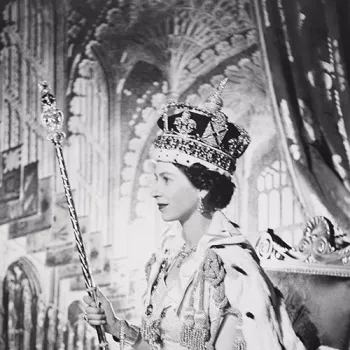
Queen Elizabeth II was crowned at Westminster Abbey on 2 June 1953. She had succeeded to the throne the previous year following the death of her father, King George VI. Her Coronation was the first to be broadcast live on television, with 27 million people in the United Kingdom tuning in to watch the ceremony.
Queen Elizabeth II’s Coronation dress can be considered as one of the most significant pieces of British dress created during the 20th century. It is both traditional, in its designated form as a piece of coronation clothing, while also being contemporary in its design.

Norman Hartnell
The Queen selected Norman Hartnell, the leading British couturier, to design her Coronation dress. According to Hartnell’s own account, he was given relatively free rein to set about his painstaking research into previous coronations of queens regnant (a female monarch who reigns in her own right), while thinking of:
altar clothes and sacred vestments … and everything heavenly that might be embroidered upon a dress destined to be historic.
Norman Hartnell
It was also necessary to consider how the dress would work under the glare of lights and cameras, this being the first Coronation to be fully televised.

The Dress Design
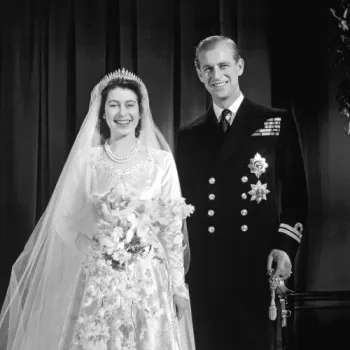
The Queen indicated to Hartnell that the dress should conform to the line of her wedding dress, which he had also designed, and that the material should be of white satin.
Hartnell submitted eight varying designs for the Queen’s consideration, and she selected the eighth design, but determined the final appearance herself by requesting that the gold and silver embroidery be enhanced by the introduction of coloured silks, thereby enriching the traditional white and gold colour scheme.
The dress was thus a change from earlier coronation dresses of the 20th century, such as those of the queen consorts Queen Mary and Queen Elizabeth, which were restricted to gold or silver embroidery. A Queen Consort is the title for the wife of a monarch.

In addition to the application of coloured silks to the embroidery scheme, the Queen also insisted that the floral emblems of the United Kingdom – the Tudor rose, Scottish thistle, Irish shamrock and Welsh leek – should be supplemented to include the emblems of the Dominions of which she was now Queen: Australia (wattle), New Zealand (silver fern), Canada (maple leaf), India (lotus), Pakistan (wheat, cotton and jute), Ceylon (now Sri Lanka, also the lotus) and South Africa (Protea).
Following detailed research, samples of the finely worked emblems were made for final approval, and these are still in their original wooden hoops. Hartnell records that by the end of October 1952 the final finished sketch of the dress together with the embroidery samples for each of the emblems were presented to the Queen for approval.


The final design was worked into a fully finished sketch, which Hartnell showed to journalists the day before the Coronation. He also prepared a special presentation sketch to be given as a gift to the Queen.

Craftsmanship
The Coronation dress demonstrated the remarkable skill of the many people involved in its creation, from the design talents of Hartnell and his assistant, Ian Thomas, to the skills of the head of the workroom constructing the dress, Madame Isabelle, and to Miss Edie Duley, the head of the embroidery workroom.
The silk for the Coronation dress was produced at Lady Hart Dyke’s silk farm at Lullingstone in Kent. The ivory silk satin was then woven by Warner & Sons of Braintree, Essex. The construction of the dress was critical, particularly to give the necessary shape to the large crinoline skirt and to support the great weight of the embroideries. The skirt has a slight train and was constructed with a backing of cream taffeta reinforced with horsehair and linen.

The photographer Cecil Beaton, on watching the Queen processing down the aisle of Westminster Abbey during the Coronation, described the movement of the dress in his diaries:
as she walks she allows her heavy skirt to swing backwards and forwards in a beautiful rhythmic effect.
Cecil Beaton

Embroidery
The richly encrusted and beautifully executed embroideries are carried out in pearls, crystals, bugle beads, sequins and gold and coloured silk threads, arranged in three scalloped, graduating tiers that fall from the slightly pointed waist. Each tier as well as the edge of the skirt, the neckline and the sleeves area bordered with alternating lines of gold bugle beads, diamantes and pearls. This combination of pastel colours and large amount of embroidery is one of the most notable features of the Coronation dress.


The technique for transferring the embroidery design created by Hartnell and his embroiderers to the fabric was done by tracing the design onto tracing paper, placing the tracing paper on the fabric and pouncing (pricking through the paper with a pouncing machine) onto the fabric. The pricked design was then drawn over with pencil.
Once completed each pattern piece of the dress was then untacked and individually embroidered using the tambour technique before being sewn together to form the final dress, the seams re-embroidered to ensure the joins were invisible. Hartnell added a final special touch by adding an embroidered four-leafed clover for luck, positioned on the skirt so that the Queen could gently touch it with her left hand.

Sign up to our enewsletter
Sign up to our emails for more stories from the Royal Collection.
We will look after your data in accordance with our Privacy Notice.
Royal Dresses at the Coronation
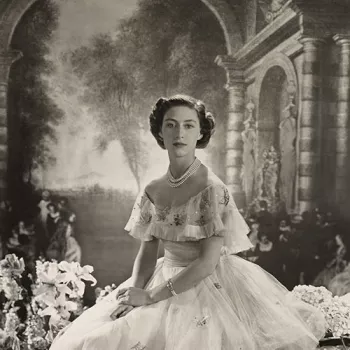
Hartnell was responsible for designing the dresses of several other female members of the royal family who attended the Coronation, including the Queen Mother, Princess Margaret, the Duchess of Kent and Princess Alexandra, as well as the dresses worn by the six Maids of Honour, thereby creating an unprecedented cohesive sense of elegance and style for the occasion.

Legacy
The final chapter of Hartnell’s autobiography, Silver and Gold is, in effect, a tribute to the dress and the Coronation, and it acts as a reminder of the many hands, often unnamed, that transform a couturier’s visions into a remarkable, and in this case historically significant, piece of fashion.

The design and production of Queen Elizabeth II’s Coronation dress as part of the wider historic design narrative of her Coronation has been scrutinised over the following decades. In 2012 the Victoria and Albert Museum in London mounted an exhibition in celebration of British design during the years 1948 to 2012. In the exhibition publication, it was recorded that the:
ceremonial splendour of the Coronation, embodied in the glorious decoration of the Queen’s body, played an important role in bolstering the political and social cohesion of the nation.

Queen Elizabeth II: Her Life in Style
Explore of a century of royal style in the largest-ever exhibition of the late Queen’s fashion.
Queen Elizabeth II: Fashion and Style
This beautifully illustrated book - the official centenary publication - offers an unprecedented look inside Queen Elizabeth II's royal wardrobe.


The Centenary of Queen Elizabeth II
Celebrate 100 years since Queen Elizabeth II's birth with our special exhibition and programme of events.


