Greatest Arms and Armour at Windsor Castle
From armours made for Henry VIII to dazzling displays of swords and firearms, discover the highlights in the Collection.

Reading time: 10 minutes
The Royal Collection holds one of the finest collections of arms and armour in the world. Some of the most outstanding examples of the armourer’s art can be seen up close on your visit to Windsor Castle, including armours made for Henry VIII, Charles I and an armour for Henry, Prince of Wales. The Castle also has dazzling displays of swords, firearms and weapons of world class artistry, beauty and technical accomplishment.
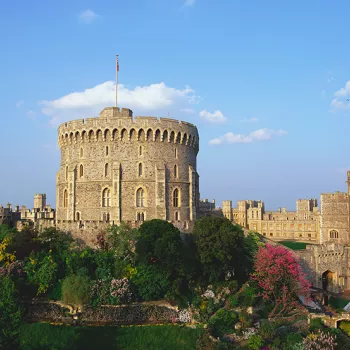
Discover some of the greatest arms and armour highlights, on view at Windsor Castle in the Queen’s Guard Chamber and Lantern Lobby.
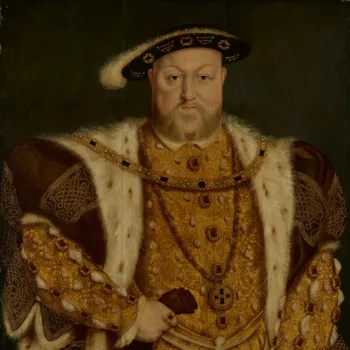
The Armour of Henry VIII

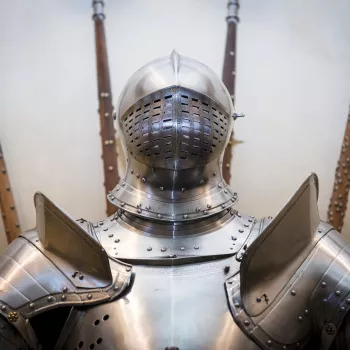
This armour was made for Henry VIII, one of the most famous Kings of England. It was made in the Royal Workshop at Greenwich – an armoury founded by Henry himself in 1515. To compete with other kings and nations, Henry assembled a team of highly skilled armourers from across Europe to create bespoke armour for himself and his court. The Greenwich Workshop continued to supply armour to the King and his nobles until the English Civil War. The Greenwich Armourers achieved sophisticated decorative effects and created innovative armours made of heat-treated steels to improve the wearer’s mobility and safety. They equalled their European rivals in the technological competition for the best designs and toughest steels.
This armour was likely made around 1539 in preparation for a tournament to celebrate Henry VIII’s marriage to Anne of Cleves, his fourth wife. Like many of the Greenwich armours, it was supplied with interchangeable pieces (an armour garniture) - a grandguard, pasguard and a manifer – so that the armour could be adapted for different uses.
The manifer from the medieval French ‘main de fer’ (hand of iron) protected the left hand when holding the reins of a horse. The pasguard protected the left elbow, and the grandguard fitted over the breastplate and helmet front to protect against lance splinters to the face, an often-fatal injury for an unlucky knight.
The hunting sword of Henry VIII

This is one of the very few swords known to have belonged to Henry VIII. It is a short single-edged hunting sword known as a hanger, which has a scabbard with a small utility by-knife. It was made by Diego De Zayas, a skilled and famous gold “damascener” (a person who inlays gold or silver into steel), who worked in Henry’s court to supply the King with the richest and best artworks.
The sword blade has been decorated in gold overlay to commemorate Henry VIII's victory at the Siege of Boulogne in France in 1544. There is a representation of the siege on one side of the blade, and a Latin verse on the other.
Learn more about Henry VIII's sword in our Collection Online.
A parade shield for Henry II of France

This is one of the finest examples of a decorated shield from a parade armour. It was made for the French court in the mid-16th century and is thought to be the work of Eliseus Libaerts, a goldsmith who worked for Henry II of France, in Antwerp. The metalwork skills employed are of exceptional skill and quality, featuring chased and embossed designs enriched with gold and silver overlays.
On the shield, there are four scenes showing key events in Julius Caesar’s life:
the Battle of Dyrrachium, where Caesar’s armour-bearer cuts off the arm of an attacker;
the moment Caesar’s robe is stained with the blood of a sacrifice;
the Battle of Pharsalus death of one of Pompey’s (Caesar’s rival) generals; and
the presentation of Pompey’s head and ring to Caesar.
The shield was presented to George III (when Prince of Wales) by John Stuart, Earl of Bute, while he was his tutor.
Learn more about the parade shield in our Collection Online.
The Brunswick armour

Parts of this armour were likely made for Duke Julius of Brunswick-Wolfenbüttel (in present-day Germany) around the mid-16th century, with the breastplate specifically dated to 1563. The armour was gifted from Hanover in 1820 and has since been added to. For instance, the greaves and sabatons covering the lower legs and feet, are reproductions made around 1800.
The quality of the decoration is exceptional and was created by acid etching. The central band of the breastplate features a winged female nude labelled ‘VENVS’ (Venus), who holds a bow in her left hand and is accompanied by Cupid on her right. Above, there is a representation of Daniel in the Lions’ Den from the Bible, framed by the inscription ‘ACH GOT BEWAR NICHT MER DAN LEIB SELE GVTVNDERE’ (O God, preserve body, soul, possessions and honour alone) – a prayer to protect the wearer.
The elaborate decorations were likely inspired by prints and book illustrations. On the backplate, the scene of Diana and Actaeon may have been adapted from the Roman poet Ovid’s Metamorphoses, which was issued in numerous editions throughout the 16th century. The etcher responsible for these illustrations would have belonged to the Brunswick painters’ guild, a group of distinguished armour-etchers. Their style was characteristically rich and busy, involving an unusual mixture of biblical, classical, sporting and heraldic subjects.
The armour was a gift to George IV from Hanover and was delivered to him at his London residence Carlton House in October 1820. It is now one of the most well-preserved examples of the Brunswick school of etched armour.
Learn more about the Brunswick armour in our Collection Online.
Armour of Sir Christopher Hatton

This extravagant armour garniture (an armour that includes interchangeable pieces) belonged to Sir Christopher Hatton, Lord Chancellor of Elizabeth I. From the armour’s imposing size, we know that Hatton was a formidable man, standing well over 6ft tall!
The design for the armour is illustrated in the Almain Armourer's Album. This contains 29 armour designs produced by the Royal Armoury at Greenwich between 1557 and 1587, the main supplier of armour to the monarch and court from the reign of Henry VIII until the English Civil War. Originally, as well as being embossed, acid etched and gilded, the armour’s finish was a magnificent bright peacock blue. This was achieved by carefully heating the steel – a process known as ‘blueing’. Hidden under the rivets, we can still see fragments of the original blued and burnished gold surface today.
Created at the height of lavish Elizabethan fashion, these armours were beautifully decorated and even followed the shapes of contemporary clothing. Despite their ornate appearance, their primary purpose was to protect the wearer, whether on the battlefield or during tournaments.
Hatton’s armour is on display alongside all its interchangeable pieces.
Learn more about Sir Christopher Hatton’s armour in our Collection Online.
Armour for Henry, Prince of Wales

This armour belonged to Henry, Prince of Wales, the eldest son of James VI and I. It is the finest and most complete Greenwich armour garniture in the world to survive and is the pinnacle of Royal Armourers art. The Royal Workshops at Greenwich were the main suppliers of armour to the monarch and court from the reign of Henry VIII until the English Civil War. Sir Henry Lee, who served as both Master of the Royal Armoury and Champion to Elizabeth I, gifted this armour to the young prince in July 1608 at a cost of £200.
It is a bespoke armour, made to fit the Prince exactly for maximum mobility, and is decorated with embossed detail, acid etching, gilding and blueing. The armour is made of hardened and tempered steel, which makes it about five times tougher than most armour of the period. It also comes with interchangeable pieces so it could be used in both battle and tournament competitions. The shaffron (a helmet to protect the horse’s head) is emblazoned with the Prince’s monogram ‘HP’ and the royal coat of arms.
The young prince was a talented sportsman; ‘he became second to no Prince in Christendom, and superior to most of those persons, who practiced with him’. A posthumous portrait of Henry by the Flemish artist Anthony van Dyck shows him wearing this armour, revealing additional details about its original appearance. Its lining was originally crimson, and its straps were covered with purple velvet edges and gold thread.
Henry died of typhoid fever in 1612 aged 18 years old, leaving his brother, the future Charles I, to succeed to the throne in 1625.
Watch our film and learn more about the craftsmanship of Henry, Prince of Wales's armour.
Foot-combat armour of Prince Charles (the future Charles I)

This armour, made in Milan, was a diplomatic gift to Prince Charles from the Duke of Savoy around 1615. It is a sporting armour made for foot-combat ‘at the barriers’, where opponents faced each other across a fence. Since there was no direct leg contact, there was no need for leg armour. The helmet is fastened to a metal collar (a gorget), allowing the wearer to turn their head freely, while keeping the helmet firmly in place. The inner arms are also fully protected by articulating lames, leaving very little of the wearer open to injury or misfortune.
The armour is richly decorated with gold and silver encrusting (thick pieces of precious metal overlaid on the steel) on a blued steel background. It is not only a striking example of craftsmanship and fashion but also reflects the expense of diplomacy and the expectation that princes needed to practise for warfare from childhood.
Learn more about Prince Charles’s armour in our Collection Online.
English security door lock with concealed pistols

George III was presented with this fascinating ‘high security’ door lock by its maker, William Walls, in 1765. It had a key with GR III and the date 1761 incorporated into the wards and combined two concealed flintlock pistols and an alarm system, reflecting George’s well-known enthusiasm for scientific instruments and mechanical innovations.
When triggered by an intruder, or thief, the mechanism would sound alarm bells (now missing) while simultaneously firing the pistols. The invention was featured in the Gentleman’s Magazine the same year, where its drawbacks were pointed out: ‘honest inadvertent people might suffer by it, who not being always recollected, might forget the danger, tho’ apprized of it and suffer for their want to memory’.
In other words, the fact that the door lock encased two hidden pistols was easily forgotten and could potentially lead to nasty end!
Learn more about the door lock in our Collection Online.
Napoleon’s flintlock gun and rifle

This magnificent ‘over and under’ sporting gun (barrels stacked one on top of the other) belonged to Napoleon Bonaparte and was said to be one of his favourite firearms. It was described as having been ‘constantly used by Bonaparte…in the forests at Fontainebleau’. The two barrels swivel, so that each can be fired by the flintlock mechanism (). Behind the lock, you can see Napoleon’s cypher inlaid in gold.
The gun was made by Jean le Page in Paris around the end of the 18th century. Le Page was one of the most talented and skilled gunmakers of the era and was part of a family-run firearms manufacturing business, which had a wide-ranging clientele, serving in succession Louis XVI, Napoleon Bonaparte, and Louis XVIII.
Lieutenant Brook of the Royal Horse Guards presented the gun to George IV (when Prince Regent) in 1817.
Learn more about Napoleon’s sporting gun in our Collection Online.
Sign up to our enewsletter
Sign up to our emails for more stories from the Royal Collection.
We will look after your data in accordance with our Privacy Notice.
The Nelson Bullet, Battle of Trafalgar, 1805

The Battle of Trafalgar, fought on 21 October 1805 as part of the Napoleonic Wars, is one of the most famous naval conflicts in British history. The British Navy, led by Vice-Admiral Lord Nelson, defeated a superior force of French and Spanish ships in a ferocious fight lasting over five hours.
This lead musket ball killed Nelson during the intense fighting. He was shot through the left shoulder by a sniper from the mizzen-top of the French ship, Redoutable. The shot was extracted from the wound by William Beatty, surgeon on board the Victory but it had already caused fatal damage to Nelson’s lungs and spine, and he died onboard the ship several hours later.
The shot is still fused with gold thread from the epaulette (an ornamental shoulder piece) of Nelson’s jacket. The fragmented lead ball is approximately 15mm in diameter, weighs around 22 grammes. After Beatty extracted the shot, it was mounted into a locket, which Beatty is said to have worn for the rest of his life. On Beatty’s death, it was presented to Queen Victoria.
Learn more about the Nelson Bullet in our Collection Online.
Field Marshal Blücher’s sword

In July 1814, following Napoleon’s abdication and exile to the Island of Elba, the sovereigns and generals of the Coalition Allies (Austria, Prussia, Russia, Sweden, the United Kingdom and several German States) were invited to England to attend peace celebrations around the country.
At a ceremony at the Royal Garrison Church in Portsmouth, Gebhard Leberecht von Blücher, a Prussian field marshal, presented George IV (when Prince Regent) with this sword. It was ‘worn by the Veteran Hero Field Marshal Prince Blücher during the whole of the Memorable Campaigns of 1813 and 1814 against the French’.
The sword is highly ornate, decorated with a gilt brass hilt and a blade with etched and gilded panels of laurel wreaths and a spray of flowers. As the personal sword of Blücher, carried throughout conflicts in Europe, it became a powerful symbol of friendship and hope for peace.
Learn more about Blücher’s sword in our Collection Online
George IV’s diamond small sword and scabbard 1820

The hilt (handle) and fittings of this sword are cast of solid gold and were likely made by a German goldsmith around 1750. The steel blade is decorated with acid etched, gilded and blued panels.
When George IV acquired the sword in 1820, the year of his coronation, he sent it to the London goldsmiths Rundell Bridge & Rundell where it was embellished with additional diamonds. Small swords were essential and fashionable parts of Georgian dress. This sword, while highly ornate, is still a functional sword.
Learn more around George IV’s sword and scabbard in our Collection Online.