

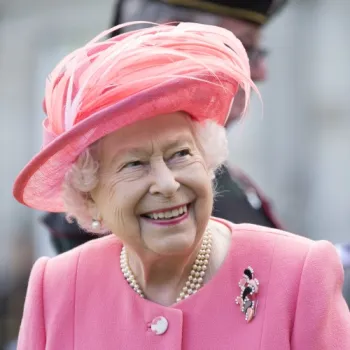
Queen Elizabeth II at the Palace of Holyroodhouse

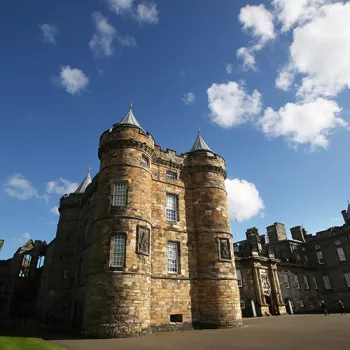
The Palace of Holyroodhouse sits at the end of Edinburgh’s Royal Mile and is home to 900 years of Scottish royal history. As the monarch’s official residence in Scotland, it was a place Queen Elizabeth II visited throughout her life. From the traditions of Holyrood Week to the events after her death, the Palace remains an important part of her story.
Queen Elizabeth II’s Scottish Residence
Queen Elizabeth II’s connection to the Palace of Holyroodhouse began early in her life. As a young princess, she joined her parents, King George VI and Queen Elizabeth, on visits to Edinburgh, including during the Coronation celebrations in 1937.
In 1947, she returned to the Palace with her fiancé, Lieutenant Philip Mountbatten. A photograph from that visit shows the couple with King George VI, Queen Elizabeth and Princess Margaret, waving to the crowds from the Palace roof.

Holyrood Week
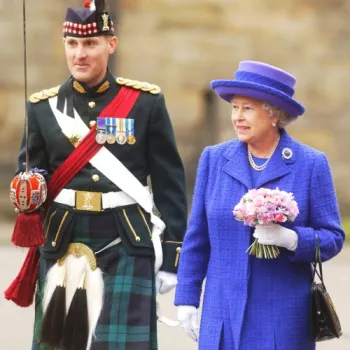
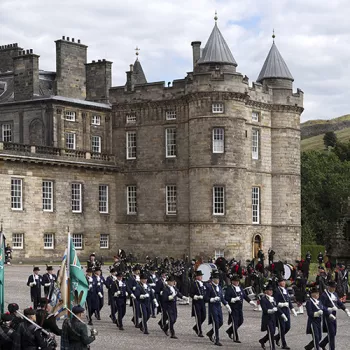
Throughout her reign, Queen Elizabeth II spent part of each summer at the Palace for ‘Holyrood Week’, also known as ‘Royal Week’. This annual visit, held in late June or early July, remains a celebration of Scottish culture, history and achievement.
When she arrived in Edinburgh, she took part in the traditional Presentation of the Keys of the City of Edinburgh. The monarch is presented with a red-velvet cushion, on which rests the great key of the city. It is handed to the monarch by the Lord Provost, who welcomes the monarch formally and pledges the city’s loyalty.

During Holyrood Week, Queen Elizabeth II carried out a full programme of engagements, from investitures and private audiences to garden parties. The annual garden party was a tradition begun by King George V and Queen Mary. Queen Elizabeth II hosted more than 50 Garden Parties during her reign, each welcoming around 8,000 guests. The guests are drawn from across the Scottish population, honouring those who have made a positive impact in their communities.
Notable figures honoured at the Palace include the Scottish actor Sir Sean Connery, who was knighted in 2000 and the Scottish rugby union player Doddie Weir, who received his OBE in 2019.


There is also a Thistle Service at St Giles’ Cathedral for Knights and Ladies of the Order of the Thistle, Scotland’s highest order of chivalry. The service takes place every other year and is followed by a luncheon or reception at the Palace. Her Majesty The Queen, The Princess Royal, The Duke of Edinburgh, and The Prince of Wales, known as The Duke of Rothesay in Scotland, have all been appointed as members of the Order of the Thistle.
King Charles III continues the traditions of Holyrood Week today.

Historic Events at the Palace of Holyroodhouse
Over the years, the Palace has hosted important international meetings, including the Commonwealth Heads of Government Meeting in 1997, as well as State Visits from Norway in 1962 and 1994 and from Sweden in 1975.
Another landmark moment came on 1 July 1999, when Queen Elizabeth II officially opened the new Scottish Parliament. The ceremony took place in the General Assembly Hall on The Mound and marked a key moment in Scotland’s modern history.
In 2010, Queen Elizabeth II welcomed Pope Benedict XVI on his State Visit to the UK. She greeted the Pope at the Palace at the start of his four-day visit to Scotland and England.
The Palace has also been used to host private events, such as the wedding reception of Zara Phillips, Queen Elizabeth II’s granddaughter, and Mike Tindall in 2011.


Where Queen Elizabeth II Stayed at the Palace of Holyroodhouse
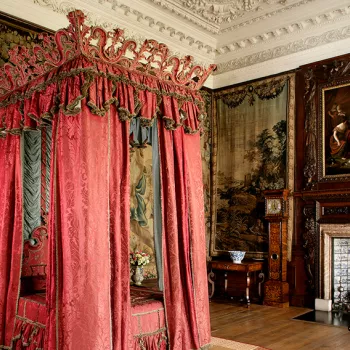
When visiting Edinburgh, Queen Elizabeth II and Prince Philip stayed in a suite of private rooms on the east side of the Palace, overlooking the gardens and Holyrood Park.
These apartments included the Royal Breakfast Room, where they would dine privately; the Dressing Room, where Queen Elizabeth II prepared for her engagements; and the Sitting Room, where she worked, held private audiences and rested.


The Royal Breakfast Room is decorated with magnificent Flemish tapestries, woven around 1650. The tapestries were hung in the room in the 1920s at the request of Queen Elizabeth’s grandparents, King George V and Queen Mary. Prince Philip’s patronage of Scottish art can be seen throughout the rooms, which display works from his personal collection. He also served as Patron of the Royal Scottish Academy of Art for more than forty years.

The private apartments will open to visitors for the first time in 2026 to mark the centenary of Queen Elizabeth II’s birth. The tours will run for 100 days and will see small groups taken behind the scenes by expert guides.
Queen Elizabeth II’s Final Journey in Scotland
Queen Elizabeth II died at Balmoral Castle on 8 September 2022, aged 96, the first monarch to die in Scotland since James V in 1542.
Her coffin travelled by road to the Palace of Holyroodhouse, where she lay at rest in the Throne Room. The next day, the coffin was taken in procession from the Palace to St Giles’ Cathedral. A service of thanksgiving was held there, attended by representatives from many different faith groups, the Armed Forces and Queen Elizabeth II’s patronages in Scotland.
The coffin then travelled from Edinburgh Airport to London. Upon the arrival of Queen Elizabeth II's coffin in London, it was transported to Buckingham Palace, before being moved to Westminster Hall for her lying-in-state. On 19 September, the state funeral was held at Westminster Abbey prior to the committal service in St George's Chapel, Windsor Castle.
The Centenary of Queen Elizabeth II
Celebrate 100 years since Queen Elizabeth II's birth with our special exhibition and programme of events.


