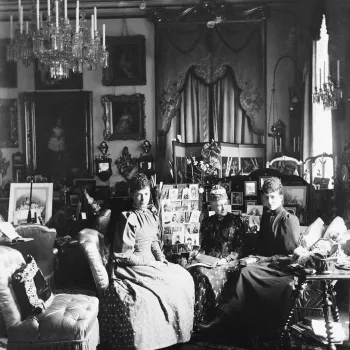
The Royal Collection contains many photographs taken by women photographers.
Olive Edis (1876–1955)
Mary Olive Edis, known as Olive, was born in London in 1876. Her family played an important role in shaping her future as a photographer. Edis’s great-uncle, Dr John Murray, produced some of the earliest images of India while serving with the East India Company in the mid-19th century. In 1900, his daughter Caroline ‘Carrie’ Murray gifted Edis her first camera and was the subject for Edis’s first photograph.


By 1905, Edis had set up a studio with her younger sister Katharine in Sheringham, Norfolk. It was designed by Edis’s uncle, the architect Robert Edis, and included a glass roof catering to her preference for working with natural light. Edis’s early photographs documented everyday life, focussing on the local community of fisherman and their families. Reflecting on her role as a studio photographer, Edis stated that it was: ‘a life worth living, with no monotony about it, and constantly bringing the worker in touch in a very pleasant way with humanity’.
Edis’s reputation grew quickly, and she opened another studio in Notting Hill, London. Within ten years, she had become a successful studio portrait photographer with an impressive list of sitters. Notable examples include author Thomas Hardy, women’s suffrage movement leader Emmeline Pankhurst, explorer Ernest Shackleton, Prime Minister David Lloyd George, and members of the royal family, such as Prince Albert, Duke of York (the future King George VI).
Pioneer of the autochrome portrait
Edis had begun creating colour portraits using the autochrome process by 1912, only a few years after the process had been introduced. Developed by Auguste and Louis Lumière and launched in 1907, the autochrome process was the first practical commercially available method of colour photography. The process uses red, green and blue coloured starch grains to produce a unique transparency on glass, which then requires viewing through transmitted light. Edis even patented a design for a diascope, an autochrome viewer.

Britain’s first female war photographer
In March 1919, Edis was granted permission to photograph the Western Front, making history as Britain’s first female official war photographer. She was commissioned by the Imperial War Museum’s Women’s War Work Committee to document women’s contributions to the war effort on the front, as well as war-torn landscapes.


Shooting with her large glass-plate camera, Edis captured the devastating aftermath of bombing and artillery fire in northern France and Belgium. Edis’s view of the River Meuse, Verdun, contrasts the ugliness and destruction of war, shown in the series of ruined buildings surrounded by debris, with the calm and beauty of the river and natural landscape.