The Picture Gallery at Buckingham Palace
Discover how the Picture Gallery has been transformed by generations of kings and queens.

by Anna Reynolds, Surveyor of The King’s Pictures
Reading time: 6 minutes
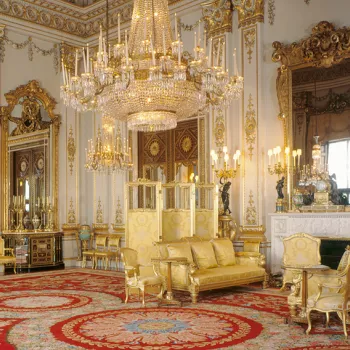
The Picture Gallery runs through the centre of the first-floor State Apartments at Buckingham Palace. Originally planned by King George IV as a space to house his magnificent collection of paintings, it was designed by the architect John Nash and created by combining Queen Charlotte’s original suite of rooms into a space 47 metres long. George IV died before seeing the project to completion and it was not until the early years of Queen Victoria’s reign that it was able to function as a gallery.
From the beginning, however, the Picture Gallery has been much more than a space to display art — it is also one of the Palace’s key reception rooms. Capable of accommodating several hundred guests, it is regularly used for banquets in support of organisations with royal patrons. It is also where people receiving honours assemble before investitures, and where special displays are put on during State Visits, with Royal Collection items selected to reflect the visiting country and highlight shared connections.
The magnificent State Rooms of Buckingham Palace, including the Picture Gallery, are also open to visitors each summer.

The Picture Gallery has never stayed the same for long. Since the 19th century, its look, layout and contents have been updated to match changing tastes, new ideas about displaying art, and the priorities of each new monarch.
Early Appearance
An 1843 watercolour reveals the room’s first appearance: biscuit-yellow walls, a crimson red carpet and red seat furniture, with paintings hung densely in three or four tiers. Smaller pictures were placed at eye level, with larger works above. In accordance with George IV’s vision, the display focused on 17th century Dutch and Flemish paintings, complemented with some later works by British artists, among them three pictures by Sir Joshua Reynolds.

The ceiling originally incorporated a row of square lantern lights and two rows of circular domed lights that provided top‑lighting — then considered essential for viewing paintings — and this was supplemented by central chandeliers.
There were also Carrara marble chimneypieces featuring medallions of famous artists (Titian, Dürer, Van Dyck and Leonardo da Vinci). The beautiful white marble is from the area surrounding the town of Carrara in Italy. These chimneypieces remain in the room today, showing the significance of the Old Master painting collection in this space.

Queen Victoria and Prince Albert rehang
In 1851, Prince Albert supervised a major rehang of the Picture Gallery, although the hang remained focused on Dutch and Flemish paintings. A watercolour from 1853 shows the display, newly arranged against lilac walls, with ceiling details picked out in terracotta and blue.
Prince Albert also initiated a programme to reframe the paintings on display, commissioning new gilded frames designed to minimise shadows across the picture surface. After Prince Albert’s death in 1861, Queen Victoria refused to alter the display he had created, and inventories reveal the hang remained exactly the same.

Edwardian Splendour and Early 20th-Century Changes
King Edward VII’s accession in 1901 ushered in a transformative phase of the Picture Gallery. The walls were painted red, a dado rail was added, and the carpet removed to expose the elaborate parquetry flooring.

Additional paintings were introduced, increasing the total to 209 and reflecting an Edwardian preference for abundant displays. A group of Italian paintings was included for the first time. Photographs from the period show an extraordinarily dense hang — five tiers high in places — yet with the established convention of placing smaller works on the lower tier.

During the reign of George V and Queen Mary, the room underwent another major refurbishment. The royal couple took great interest in the designs, the most significant change being to the ceiling, which was lowered and transformed into a glazed arch.
A decorative plaster frieze (decorative band) with floral designs was added just below the ceiling, and 362 yards of specially woven green silk damask (a type of patterned fabric) was attached to the walls. A revised but equally dense hang retained the importance of symmetry across the walls, as seen in photographs published in Country Life around 1931.

Change during the reign of Queen Elizabeth II
By the 1950s, the number of paintings in the Picture Gallery had been significantly reduced, with the arrangement limited to a maximum double tier. This reflected a mid-century taste for clearer sightlines and more generous spacing.
A 1953 photograph of Queen Elizabeth II with her prime ministers shows this hang, with Van Dyck’s painting of Charles I, Henrietta Maria and their two eldest children given a prominent position.

The earliest colour photographs of the Picture Gallery date from the 1960s and reveal that the wallcoverings were still green, with co-ordinating seat furniture and rugs.
In 1976, Queen Elizabeth II oversaw another redecoration programme. Coral-pink coloured silk/cotton velvet was installed, and the frieze painted a pale pink to bridge between the white ceiling and the walls. A two‑tier hang was maintained, but with enhanced symmetry — four small pictures arranged around one or two larger central works in each bay.
Paintings were grouped broadly by school, progressing from Dutch to Flemish to Italian and French.


The Picture Gallery Today
In 2026, a re-presentation of the Picture Gallery took place. This reflects the tastes of King Charles III and drew on research into historic hangs and architectural schemes, using archival photographs and inventories alongside in-situ investigations. The walls are now hung with green silk damask, and the upper frieze restored to white. The painted door surrounds were stripped back to reveal the original marble beneath.

A denser picture hang was adopted, increasing the number of displayed paintings from 63 to 120 — a balance between Edwardian abundance and mid-century restraint. A key concern was to maintain the greatest level of quality and condition. Works continue to be arranged by shared geographical origin, period or subject.
The smallest painting newly on display is Gerrit Dou’s exquisite A Maidservant Scouring a Brass Pan at a Window, only 16 cm high unframed, which has been recently conserved to reveal its intricate details.


Another painting newly conserved for the redisplay is A Young Man with a Falcon. Once believed to be by Rubens when acquired by George IV, it is now attributed to Jan van Boeckhorst. Clearly visible in photographs from around 1931, inventories also reveal that it formed part of the original Picture Gallery hang of the 1840s.


Many highlight paintings from the collection that were previously hanging here remain on view as part of the new display. These include Rembrandt’s Shipbuilder and his Wife, and Vermeer’s Lady at the Virginals with a Gentleman.
The first of these demonstrates Rembrandt’s innovative approach to portraiture, which combines the skilful depiction of character with storytelling and drama.

The Lady at the Virginals with a Gentleman is one of only around 35 works by Vermeer that are known, making it a rare example of the artist’s work. It illustrates Vermeer's ability to turn a relatively simple everyday subject into something poetic through a carefully balanced composition and focus on the subtle play of light across the various surfaces.


As a nod to Queen Victoria and Prince Albert’s original arrangement, British 18th century works have been reintroduced, including Johan Joseph Zoffany’s Tribuna of the Uffizi.

Hanging in the room in the 1840s, the first decade of Queen Victoria and Prince Albert’s reign, this fits especially well in the display today. It depicts a gallery filled with treasured artworks, and celebrates the enjoyment, discussion and appreciation of art — the very spirit the Picture Gallery continues to embody today.
Watch Buckingham Palace's Picture Gallery transform | Timelapse Copyright: Royal Collection Enterprises Limited