History of the Venus Garden

Reading time: 4 minutes
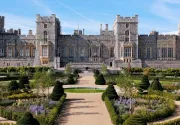
The Venus Garden is a large royal garden set beneath the famous east side of Windsor Castle. Formerly known as the East Terrace Garden, it was redesigned according to His Majesty The King's vision. Windsor Castle and the surrounding grounds has a long royal history stretching back 1,000 years. Read on to discover how different generations of the Royal Family have changed and shaped these gardens.
This summer, visitors to Windsor Castle can walk through the newly updated garden as part of their visit.
Charles II’s Bowling Greens
In the 1650s, the open fields of the Little Park (now the private Home Park) reached right up to the moat ditch that once surrounded the whole Castle. During the 1670s, in the reign of Charles II, the North Terrace of the Castle was extended around the east and south sides.
The land just east of the new East Terrace was flattened and transformed into a series of three bowling greens. These bowling greens appear on a 1742 plan of Little Park. Charles II was a keen player of lawn bowls and is said to have created the first set of rules for the game.

Creating the East Terrace Garden
The original East Terrace Garden was created during the reign of George IV, who had long disliked the lack of privacy at the Castle. In 1823, Charles Long, 1st Baron Farnborough, made a first sketch design for an enclosed formal garden below the east front. Sir Charles Long was an English politician and artistic advisor to George IV. The King ordered the closure of an old public footpath that ran through the Little Park from the south-eastern corner of the Castle to the river crossing at Datchet.
The Little Park was still open to the public, so the newly enclosed East Terrace Garden gave the King more privacy. It also made sure that his newly created suite of rooms on the east side of the Castle looked out into a beautiful garden. These rooms are now known as the Semi-State Apartments and can be visited in the winter months.

Early Design, Planting and Sculptures
The final design of the garden was created by architect Jeffry Wyatville, who oversaw all the King’s building works at Windsor. The planting of the garden itself was almost certainly the responsibility of W.T. Aiton, Director of the Royal Gardens.
Once completed, the garden was filled with plants, including some exotic examples, and sculpture. Sadly, in the winter of 1837–8, most of the plants in the garden died and had to be replaced. The garden contained a collection of garden sculpture of international importance. The bronze figures were of classical gods, goddesses and a Roman gladiator and were cast in Rome in the 1630s for Charles I. He first displayed them in his gardens at St James’s Palace and at Whitehall Palace.
After Charles I’s execution in 1649, Oliver Cromwell’s government sold off most of his art collection, including the Hubert le Seur’s sculpture of the gladiator. This was one of the many works returned to the Royal Collection during the reign of Charles II. George IV had the figures brought to Windsor from the Privy Gardens at Hampton Court Palace in 1829 for the new garden.

The Orangery, a glass-fronted conservatory built into the wall of the garden, housed 34 orange trees, a gift to George IV from Charles X, King of France.

Opening the Gardens in Victorian Times
Unlike George IV, his successors William IV and Queen Victoria allowed the public to walk on the Castle’s terraces, and in the East Terrace Garden. During Queen Victoria’s reign, people could visit the North Terrace every day and the East Terrace at weekends.


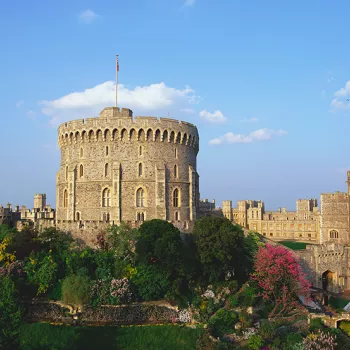
A passage of stairs was added under the terrace from the Prince of Wales Tower (the far-right tower if you were looking directly at the Castle from the gardens). This allowed the royal family to reach the Orangery without being seen, as they had little privacy in the East Terrace Garden.
The garden was redesigned during Queen Victoria’s reign by her husband, Prince Albert, who was actively involved in its design and planting. Queen Victoria recorded in her journal that Prince Albert took particular interest in its planting.
Albert is daily occupied…in superintending the planting of the garden in the inside of the Terrace. The plots were before so scrubby & scraggy, but are now being very nicely arranged with laurustinus, bays, &c.
Queen Victoria's Journal
He also oversaw the development of the Little Park into the present, private Home Park in 1851.

Queen Elizabeth II and the Garden
During the Second World War, 14 flowerbeds were planted with vegetables because of food shortages. Two small plots were set aside for the young Princess Elizabeth (the future Queen Elizabeth II) and Princess Margaret, to grow their own vegetables for the war effort. These included tomatoes, sweetcorn and beans.
After the war, during Queen Elizabeth II’s reign, the beds were changed into a simpler pattern planned by Prince Philip, Duke of Edinburgh. The garden contained around 3,500 rose bushes, chosen for their colour or beautiful scent.
Prince Philip was also involved in the design of a new bronze fountain for the centre of the garden, inspired by the shape of a lotus flower (a type of tropical water lily).

The Venus Garden Today
The new Venus Garden is inspired by the path of Venus as it orbits the Sun. Traced over eight years, Venus’s orbit creates a petal-like floral pattern, a shape used in sacred architecture by several cultures. This pattern has inspired the layout of new planting and hedge-lined paths.


Watch Windsor Castle's Royal Garden Transform Copyright: Royal Collection Enterprises Limited
Wildflower meadows, dotted with trees and threaded with pathways, introduce softer, more naturalistic areas within the formal layout. These spaces support many kinds of wildlife and insects, reflecting The King’s longstanding commitment to sustainability.
Along the curved edge of the garden stands a line of sculptures from the Royal Collection. These include four bronze figures by Hubert Le Sueur, originally made for Charles I in the 1630s and brought to the garden for George IV. They are complemented by large scale marble, bronze and stone vases, lead urns and other historic sculptures and garden ornaments, some newly introduced as part of the redesign.