A History of State Portraits
Discover some of the most important state portraits in the Royal Collection.

State portraiture has a long and distinguished tradition, dating back to the 16th century, when such grand images were carefully crafted to project power and royal authority. These portraits, commissioned directly from the monarch and typically showing them in regal robes and imposing settings, became the definitive public image of a new ruler. Copies were often widely distributed to courtiers, ambassadors, and foreign embassies. In this article, discover some of the most important state portraits in the Royal Collection.
King Charles III and Queen Camilla

Two different artists were selected by Their Majesties to commemorate their Coronation on 6 May 2023. The King chose to be painted by Peter Kuhfeld while The Queen selected Paul S Benney.
The King undertook two of his five sittings in the State Apartments of St James’s Palace, with its Throne Room being used as the backdrop of the portrait. Following convention, the portrait includes the Imperial State Crown, placed on a table to one side. Kuhfeld carefully captures the brilliance of the jewels as they sparkle in the morning sunlight filtering through the window. He draws particular attention to the cabochon red spinel known as the ‘Black Prince’s Ruby’ at the front of the Crown. His Majesty wears full ceremonial military dress, along with the crimson silk velvet Robe of State. The robe, embroidered with gold thread, made by Ede and Ravenscroft for the Coronation of Edward VII in 1902, was worn to enter Westminster Abbey for the first part of the service.
The Queen wears her Coronation Dress by British fashion designer Bruce Oldfield OBE. Made of ivory coloured silk, it features embroidered floral designs representing Their Majesties’ affection for the British countryside and nature. Benney has also taken care to include The Queen’s two rescue dogs, Bluebell and Beth, which are embroidered near the hem, as well as the rose, thistle, daffodil and shamrock that represent the four nations of the United Kingdom. On top of the Robe of Estate, positioned to one side, is 'Queen Camilla's crown’, originally created for the Coronation of Queen Mary in 1911.
Queen Elizabeth II

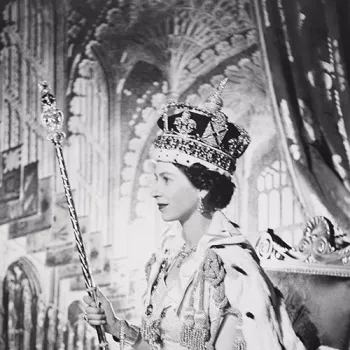
Sir Herbert James Gunn painted the State Portrait of Queen Elizabeth II to commemorate her Coronation on 2 June 1953. Gunn was a Scottish born painter who enjoyed a prolific and successful career as a portraitist.
The Queen is pictured in the Throne Room at Buckingham Palace, wearing her coronation dress – a white satin gown embroidered in various colours designed by her principal dressmaker the British couturier Sir Norman Hartnell – and the Robe of Estate. This robe, embroidered with wheat ears and olive branches (symbolising peace and plenty) was specially made for the occasion by the Royal School of Needlework and took a total of 3,500 hours between March and May 1953. Following convention, the Imperial State Crown and Sceptre are represented on the table beside her.
King George VI and Queen Elizabeth

Sir Gerald Festus Kelly, a leading society portraitist, was commissioned to paint the State Portraits of King George VI and Queen Elizabeth in 1938. With the outbreak of the Second World War one year later, the unfinished paintings were swiftly moved from Kelly’s studio in London to the safety of Windsor Castle, where he spent the next five years completing the commission. Kelly particularly enjoyed his sittings with the Queen, later reflecting warmly, ‘It is hard to suggest the admiration and affection which grew all around her’.
Kelly placed the royal couple in grand interiors based on a model of the Viceroy’s Building in Delhi by the architect Sir Edwin Lutyens, which makes the paintings appear more spacious and stately. The Queen’s coronation gown, designed by the London-based dressmaker Madame Handley-Seymour, is embroidered with the emblems of the United Kingdom, Canada, New Zealand and Australia. The Royal School of Needlework embroidered the Queen’s Robe of Estate using goldwork and featuring flowers from the Commonwealth countries, including South Africa protea and Indian lotus flower.
King George V and Queen Mary

King George V and Queen Mary each commissioned a different artist to paint their state portraits to commemorate their Coronation on 22 July 1911. The King selected Sir Samuel Luke Fildes having admired his State Portrait of Edward VII (his father), which Fildes had completed 10 years earlier. He remarked ‘We get on very well together’. In contrast, George appears smaller and more reserved. The downward angle of his sword reinforces his calm, restrained presence, making him appear less flamboyant than his father. Fildes was clearly influenced by the majestic State Portraits of George III and George IV, with the monarch standing prominently before a backdrop of sweeping drapery.
Sir William Samuel Henry Llewellyn painted Queen Mary’s portrait. Mary wears a white satin gown designed by the London court dressmaker Reville and Rossiter. The gown was embroidered by the Princess Louise Needlework school in gold thread with a pattern incorporating the English rose, Scottish thistle, Irish shamrock, star of India, lotus flower of India, and English oak leaves and acorns. She is adorned with George IV’s State Diadem, as well as Queen Victoria’s diamond stud earrings and collet necklace. Next to her right hand, we can see the crown that was specially designed for the 1911 Coronation, now known as ‘Queen Camilla’s Crown’.
Sign up to our enewsletter
Sign up to our emails for more stories from the Royal Collection.
We will look after your data in accordance with our Privacy Notice.
King Edward VII and Queen Alexandra

Sir Samuel Luke Fildes painted the State Portraits of both King Edward VII and Queen Alexandra. Fildes was also inspired by the imposing portraits of George III and George IV by Allan Ramsay and Sir Thomas Lawrence, respectively.
Fildes presents Edward VII surrounded by the regalia. Sittings took place in the artist’s studio at Melbury Road, where the King never assumed the standing pose but instead sat in an armchair on a dais. Writing to his sister, after just one sitting, the King felt the portrait
promises to be good. I am represented in General’s Full-Dress uniform with the red velvet & ermine cloak life size. I hope that Alix will have a pendant & they will be hung at Buck: Palace
In his painting of Queen Alexandra, Fildes presents a seemingly conventional, formal state portrait, including all the traditional accoutrements of monarchy, yet Queen Alexandra offers the viewer a personal image. Her dress, embroidered with royal emblems, is closer to the decorative tradition of Danish coronations. Among the profuse layering of diamond and pearl jewellery, she wears the Dagmar necklace Both dress and jewellery therefore honour her Danish heritage.
Queen Victoria and Prince Albert

Franz Xaver Winterhalter painted numerous portraits at the English court from 1842 until his death. Among his most celebrated works were the 1859 State Portraits of Queen Victoria and Prince Albert, which were regarded as their new official likeness. Victoria had expressed strong dislike for her earlier state portrait by the Scottish artist Sir David Wilkie, painted upon her accession in 1837, calling it ‘one of the worst pictures I have ever seen’. A few years later, Sir George Hayter produced an official Coronation portrait of the Queen – shown unconventionally seated and looking upwards - in full royal regalia.
Following her marriage to Prince Albert in 1840, preference was soon given to German painters such as Winterhalter. In his 1859 portrait of Victoria, she wears the Robe of State and diamond diadem alongside the dazzling diamond circlet, earrings and necklace made by the first official Crown Jeweller, Garrard’s, one year earlier. Her left hand rests on some papers next to the Imperial State Crown and in the distance, we can see a view of Westminster.
Prince Albert is portrayed with equal grandeur. He wears the uniform of Colonel of the Rifle Brigade, the ribbon and star of the Order of the Garter and the badge of the Golden Fleece – symbols of honour and chivalry. His military shako, the distinctive head-dress common in most European armies since 1800, is placed on a stool to his left.
When the two portraits were unveiled, the Queen described them as ‘truly magnificent'.
George IV

Sir Thomas Lawrence was the most celebrated portraitist of the early 19th century, undertaking numerous commissions for George IV, most notably the series of portraits in the Waterloo Chamber at Windsor Castle. This imposing state portrait was painted in 1821 to hang in the Throne Room at St James’s Palace, where it can still be seen today. It records the extraordinary crimson velvet robes designed by the King himself for his coronation ceremony. George is portrayed larger than life, standing next to the Table des Grands Capitaines de l’Antiquité, a gift from Louis XVIII, King of France after the Battle of Waterloo in 1815, which effectively marked the end of Napoleon’s reign. George clearly thought very highly of the gift, which featured in all his state portraits.
George III and Queen Charlotte

George III appointed the Scottish painter Allan Ramsay as ‘one of His Majesty’s Principal Painters in Ordinary’. In his State Portrait, the young King aged 22 years old, strikes an elegant pose that emphasises his dignity and reserve. He is shown standing in a grand setting framed by columns and drapery. The portrait reflects the practice of lending clothing to artists after the initial sitting to avoid the subject being required to sit for lengthy periods. On 19 December 1761 Ramsay reported that he had ‘the Royal robes set up upon my figure’.
Ramsay’s painting of George III forms a pair with the State Portrait of Queen Charlotte. The Queen’s magnificent collection of jewellery was widely admired by contemporaries. One of her collection’s most noteworthy pieces was the diamond stomacher depicted in her portrait. Created from a fine network of small diamonds and overlaid with a foliate design of larger stones, the Queen wore it to both her wedding and coronation.
There was a huge demand for copies of Ramsay’s portraits. Orders for 150 pairs, 26 of the King alone and 9 of the Queen alone are listed.
George II and George I

John Shackleton was Principal Painter in Ordinary to George II from 1749 until his death in 1767, when he was replaced by Allan Ramsay. This studio version of George II’s State Portrait was probably acquired by George IV around 1820. It was included as part of the display of dynastic portraits created for Queen Victoria in the State Dining Room at Buckingham Palace in 1841.
Godfrey Kneller, a German-born painter, was renowned for his portraiture in the late Stuart and Georgian eras, serving as court painter to seven successive British monarchs. The prime version of his State Portrait of George I, the ‘only picture for which he ever sat in England’, is not in the Royal Collection, but at Houghton Hall in Norfolk. It was given by George to his Prime Minister, Sir Robert Walpole. This studio copy is on display in St George’s Hall at Windsor Castle.
William III and Mary II

Godfrey Kneller’s pair of State Portraits of William III and Mary II – England’s first and only joint monarchs – also hang in St George’s Hall at Windsor. Both the King and Queen are shown wearing their ermine-lined coronation robes, while in each the royal regalia is displayed prominently on a table draped in red cloth. The arrangement of William’s portrait closely resembles Sir Anthony van Dyck’s famous painting of Charles I. It was perhaps a deliberate choice by the newly arrived Dutch King, to remind his subjects that he was Charles I’s grandson.
Charles I

Sir Anthony van Dyck was a Flemish artist who became the leading court painter in England during the reign of Charles I. He painted around 40 portraits of the monarch. With this portrait dating from 1636, Van Dyck established a formula – the column, looped curtain and varied positioning of the regalia – that was to be developed in later centuries.
The artist cleverly solved the challenge of the King’s modest stature by painting from a low vantage point, making viewers look up to create a striking illusion of grandeur.
James VI and I

This is the earliest single-figure state portrait showing the monarch in coronation robes to survive in the Royal Collection. It was directly commissioned by James I and VI in around 1620, from the Flemish artist Paul van Somer. The King is portrayed as an impressive monarchical presence, holding the orb in his left hand and the sceptre in his right, crowned and wearing the collar and badge of the Order of the Garter. The sumptuous fabrics he wears are set against the richly decorated interior of a room at Whitehall Palace.